Walk across the roof of almost any commercial building and the HVAC equipment is right there in front of you. Rooftop units lined up across the deck, curb-mounted and working quietly, or sometimes not so quietly. For many commercial buildings, that rooftop equipment represents one of the largest ongoing operational costs and one of the most significant capital expenditure risks on the property.
A commercial HVAC assessment is not just checking whether the units turn on. It is a structured evaluation of condition, performance, age, maintenance history, and estimated remaining useful life across every major component in the system.
At LiteHouse Commercial, commercial HVAC inspection is a core component of every commercial property assessment. This guide explains what a thorough assessment covers across the three main system types found in commercial buildings: rooftop units (RTUs), make-up air units (MAUs), and split HVAC systems.
Here is what this guide covers:
- What commercial HVAC assessment involves
- Rooftop unit inspection: what gets checked and what fails
- Make-up air unit inspection: what makes these different
- Split HVAC system evaluation in commercial settings
- How HVAC condition affects capital planning
- What maintenance records reveal during an assessment
What a Commercial HVAC Assessment Actually Involves
A commercial HVAC inspection is not a service call. The goal is condition assessment and life expectancy estimation, not diagnosing a specific fault or making repairs.
The inspector documents:
- System types, age, and capacity
- Physical condition of units and components
- Evidence of maintenance or deferred maintenance
- Observed operational performance during the inspection
- Known or likely deficiencies
- Estimated remaining useful life
The output feeds into a property condition report, a capital expenditure forecast, or a due diligence report for a transaction. The data is used by owners, investors, property managers, and lenders.
An HVAC system evaluation that covers all three system types, such as RTUs, make-up air units, and split systems, gives a complete picture of a building's climate and air management infrastructure.
Rooftop Unit Inspection: What Gets Checked and Where Problems Appear
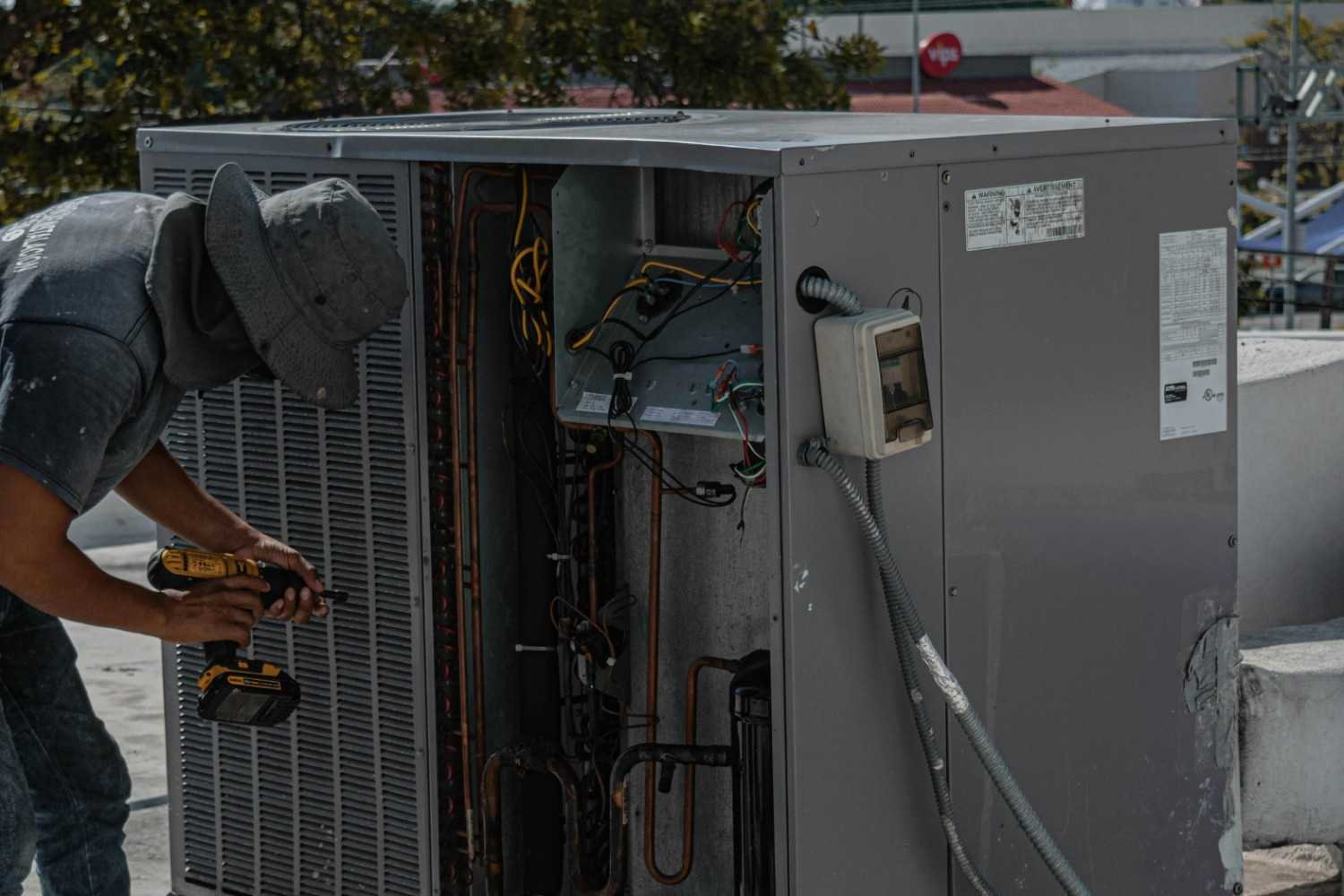
Rooftop units are the workhorses of commercial HVAC. A mid-size office building may have anywhere from four to twenty RTUs depending on the building's age, layout, and zoning approach.
RTU inspection covers these key areas:
Age and model documentation – Manufacturer, model number, serial number, and estimated manufacture date. Age is a critical factor in RUL estimation. Most commercial RTUs have a rated life of 15 to 20 years. Units beyond that age in any condition warrant careful attention.
Physical condition of the cabinet and housing – Rust, corrosion, physical damage, and penetrations in the housing that allow water entry. Rooftop units are exposed to all weather conditions. Units that have lost protective coating or have significant cabinet rust are often aging faster than their age alone would suggest.
Coil condition (both evaporator and condenser coils) – Coils are critical to heat transfer. Dirty, corroded, or physically damaged coils reduce capacity and efficiency. Coil fin condition is checked and any evidence of coil leaks is documented.
Refrigerant system – Evidence of refrigerant leaks (oil staining around components, frost formation in wrong locations), refrigerant type (older R-22 refrigerant units face significant replacement cost implications), and any pressure or performance indicators accessible without intrusive testing.
Compressor condition – The compressor is the highest-cost component in an RTU. Unusual sounds, hot spots, or electrical anomalies during operation are documented. Compressor failure often makes RTU replacement more economical than repair.
Heat exchanger condition (for gas-fired RTUs) – Cracked heat exchangers allow combustion gases to mix with supply air, a health and safety concern. This is a critical inspection point on gas-fired units. Visual inspection with appropriate lighting is standard; dye or pressurization testing may be recommended if visual findings are inconclusive.
Economizer operation – Many commercial RTUs include economizers that allow free cooling by bringing in outdoor air when conditions permit. Faulty economizers are extremely common and represent a significant energy waste. Economizer dampers that are stuck open, stuck closed, or controlled by failed actuators all affect HVAC performance and energy costs.
Electrical components – Contactors, capacitors, disconnect condition, and control board function. Aged or pitted contactors are a common maintenance finding. Failed capacitors are a frequent service call item.
Filtration – Filter condition reflects maintenance practices. New filters during an inspection can mask recent deferred maintenance patterns but filter housing condition usually tells a more honest story.
Drain pan and condensate drainage – Blocked drain pans lead to water damage inside the unit and can overflow into the building below. Standing water in drain pans is a finding that requires follow-up.
Curb and roof penetration condition – How the RTU is mounted to the roof affects both the unit's integrity and the roof's waterproofing. Deteriorated curb flashing is a common finding that affects both the HVAC and the roofing system.
Make-Up Air Unit Inspection: What Makes These Different From Standard RTUs
Make-up air units serve a different purpose from standard heating and cooling RTUs. While RTUs recirculate and condition existing building air, make-up air unit inspection requires understanding a system designed to bring in a controlled volume of fresh outside air to replace air exhausted from the building.
Make-up air units are common in commercial kitchens, laboratories, industrial spaces, and buildings with significant exhaust systems. They ensure proper pressurization, replace exhausted air, and prevent negative pressure conditions that cause doors to be hard to open and allow uncontrolled air infiltration.
What differentiates make-up air unit inspection:
Airflow balance verification – The volume of air being supplied by the MAU should roughly match the volume being exhausted by the building's exhaust systems. Significant imbalance creates pressure problems. During an inspection, documentation of supply and exhaust volumes from available commissioning data helps identify potential imbalances.
Heating capacity and heat exchanger condition – Make-up air units often have substantial heating capacity because they are conditioning cold outdoor air before introducing it to the building. Heat exchangers, whether direct-fired gas burners, indirect gas-fired, or electric, are inspected for condition, evidence of leaks, and proper flame patterns on combustion units.
Direct-fired vs. indirect-fired operation – Direct-fired MAUs inject combustion products directly into the airstream (carefully controlled to complete combustion). These units require specific inspection attention to flame sensor condition, burner adjustment, and combustion analysis documentation. Indirect-fired units are more forgiving but have their own heat exchanger integrity considerations.
Inlet screening and filtration – The outdoor air intake must be screened against birds, debris, and precipitation. Damaged inlet screens allow contamination of the air supply.
Damper operation – MAUs include outdoor air dampers that should close when the unit is off to prevent unwanted air infiltration. Failed open dampers cause significant heating or cooling loads. Damper actuator condition and end-position behavior are checked.
Discharge air temperature verification – Where possible, confirming that discharge air temperature aligns with design setpoints gives a functional performance indication.
Split HVAC System Evaluation in Commercial Settings
Split systems, where a refrigerant-charged outdoor condensing unit connects to one or more indoor air handlers or fan coil units, are common in smaller commercial buildings, server rooms, specific zones within larger buildings, and as supplemental cooling for areas with high heat loads.
Commercial split HVAC system assessment covers:
Outdoor condensing unit condition – Same considerations as the outdoor components of an RTU: coil condition, refrigerant system integrity, compressor condition, electrical components, and housing condition.
Indoor air handler condition – Coil cleanliness, drain pan condition, blower motor and wheel condition, and filter maintenance.
Refrigerant line condition – The insulated copper lines running between outdoor and indoor units degrade over time. Damaged insulation reduces efficiency. Line routing should protect lines from physical damage.
Line set length and age – Very long line sets between outdoor and indoor units carry efficiency penalties and increase the risk of refrigerant charge issues over time.
Control system functionality – Thermostat or building automation system integration, setpoint verification, and staging behavior in multi-stage or variable-speed systems.
Refrigerant type – As with RTUs, systems using R-22 refrigerant face supply and cost challenges for servicing. Split systems still running R-22 are candidates for earlier replacement planning even if they are still functional.
Supplemental systems in critical spaces – Split systems used for server room or IT space cooling are critical systems. A failed split in that application can cause rapid equipment damage. The presence and condition of redundant or backup cooling in those spaces is documented.
How HVAC Condition Affects Capital Planning for Commercial Properties
HVAC is typically one of the two or three largest capital expenditure items in a commercial property's lifecycle. Understanding the current condition and estimated remaining life of each unit is central to responsible capital planning.
Near-term needs (0 to 3 years) – Units that are at or past expected lifespan, showing significant mechanical degradation, or running on obsolete refrigerant with limited service options should be in the near-term capital budget.
Medium-term needs (3 to 7 years) – Units mid-way through expected lifespan with moderate deferred maintenance. These need monitoring and planned budget allocation.
Long-term considerations (7+ years) – Recently installed or well-maintained younger units. These inform longer-range planning but are lower urgency.
For investors evaluating a commercial acquisition, HVAC assessment findings directly affect the financial model. Systems needing near-term replacement represent known capital costs that should factor into pricing, reserve analysis, and loan underwriting.
What Maintenance Records Reveal During a Commercial HVAC Assessment
Maintenance records, where available, significantly enhance the accuracy of any commercial HVAC assessment.
Regular service records indicate a well-maintained system that may have more remaining useful life than age alone suggests. Gaps in service records, or records that show only reactive maintenance (repairs called in response to failures rather than scheduled preventive work), indicate a higher likelihood of latent issues and a shorter effective remaining life.
Refrigerant addition records are particularly informative. A unit that has received refrigerant additions repeatedly over several years has a persistent leak somewhere in the system. The leak location matters. Some are easily repaired, others indicate compressor seal failure that makes repair economically questionable.
Filter change records indicate whether basic maintenance has been performed. Units that have not had filters changed regularly have coils that have been working against increasing airflow resistance for extended periods. That translates to higher operating temperatures and reduced compressor life.
Conclusion
Commercial HVAC assessment is detailed work that requires understanding how each system type operates, what good condition looks like, and how observed findings translate to remaining useful life estimates. RTUs, make-up air units, and split systems all have distinct inspection considerations and failure modes.
LiteHouse Commercial conducts thorough commercial HVAC inspection as part of comprehensive commercial property assessments. Whether the goal is a pre-purchase condition assessment, a capital planning baseline, or an independent verification of system condition for a transaction, an accurate HVAC evaluation is one of the most valuable pieces of information a commercial property stakeholder can have.
Frequently Asked Questions
Can a commercial HVAC assessment determine exact energy consumption of each unit?
A standard visual condition assessment cannot measure exact energy consumption without monitoring equipment installed over time. However, inspectors can note conditions that indicate poor energy efficiency, such as dirty coils, failed economizers, incorrect refrigerant charge, damaged insulation, and these findings can be used to estimate efficiency losses compared to properly maintained equipment. Energy auditing as a separate engagement provides more precise consumption data.
What’s the difference between an HVAC inspection and a normal service call?
An inspection is basically someone coming in to look over the system and tell you what shape it’s in. They’re not there to repair anything. A service call is when someone actually cleans things, fixes small problems, or gets the system running better again.
How does a building automation system affect an HVAC check?
If the building has a good automation system, it makes it easier to see how the HVAC has been running over time instead of just looking at it for one day. You can spot patterns and problems a lot faster that way.
But if the system is old or set up badly, it can actually cover problems up instead of helping. Sometimes things keep running wrong in the background and nobody notices until the bills go up or equipment starts wearing out faster.