If you are buying or financing a commercial property, someone is going to recommend an inspection. Depending on who you are talking to, that recommendation might be for a Commercial Property Inspection following ComSOP, or a Property Condition Assessment following ASTM E2018-24.
Both involve a professional walking through a building and telling you what they find. Beyond that, they are meaningfully different in scope, purpose, cost, and what you can actually do with the results.
Understanding the difference helps you make the right call for your specific situation, instead of defaulting to whatever your broker or lender suggests without knowing why.
Here is what we will cover:
- What a ComSOP Commercial Property Inspection is
- What an ASTM E2018-24 Property Condition Assessment is
- How the two approaches differ in practice
- The pros and cons of each
- Which situations call for which approach
- How LiteHouse Commercial helps you decide
What Is a ComSOP Commercial Property Inspection?
ComSOP stands for the International Standards of Practice for Inspecting Commercial Properties. It is a defined set of standards that tells a commercial property inspector exactly what they are expected to look at, document, and communicate to the client. Think of it as the rulebook that keeps a commercial inspection thorough and consistent, regardless of who conducts it.
A ComSOP inspection is not a quick walk-through. It is a systematic assessment of the building from top to bottom, covering every major system and component that affects the property's condition and value.
The inspector works through the building methodically, assessing:
- Structural components including the foundation, framing, and load-bearing elements
- Roof systems and exterior cladding
- Mechanical systems including HVAC equipment and distribution
- Electrical systems including service, panels, and wiring
- Plumbing systems including supply, drain, and waste
- Life safety systems including fire suppression and alarms
- Interior components including floors, walls, ceilings, and doors
- Site conditions including drainage, paving, and accessible areas
When the site visit is complete, you receive a detailed inspection report that documents observed conditions, flags deficiencies, and includes photographs throughout. Where a specific system warrants deeper review, the report will say so and recommend the appropriate specialist.
One practical advantage worth noting: a ComSOP inspection is conducted by a qualified commercial property inspector. You do not need to bring in an engineering firm or assemble a multidisciplinary consulting team to get a thorough, professional result.
What Is an ASTM E2018-24 Property Condition Assessment?
PCA stands for Property Condition Assessment, and the current governing standard for how one is conducted is ASTM E2018-24, published by ASTM International.
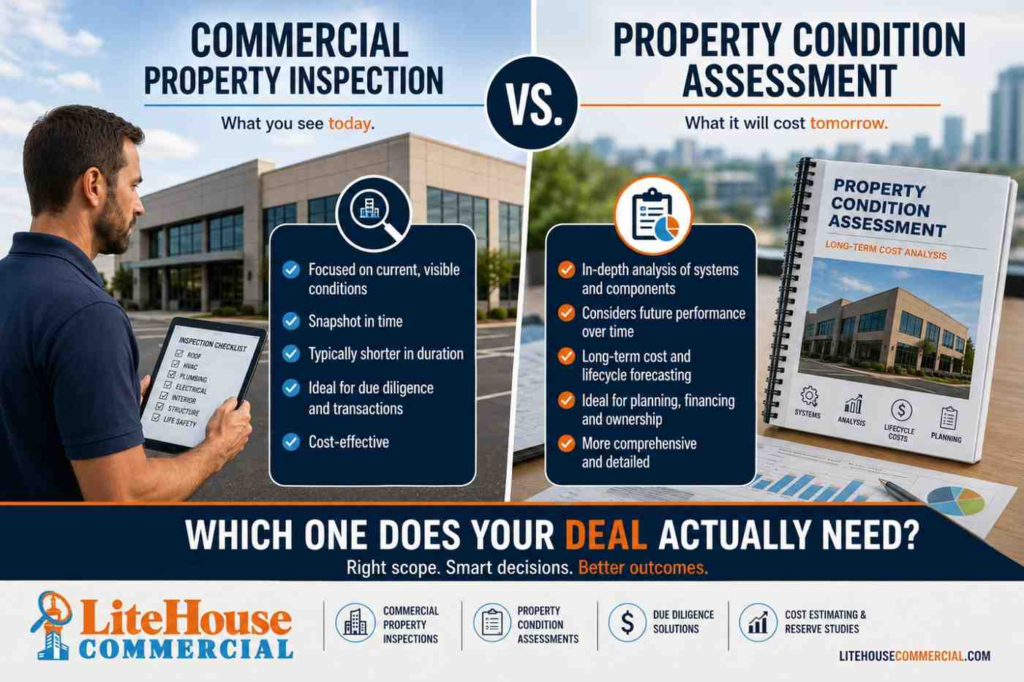
A PCA is a more formal and more document-intensive process than a ComSOP inspection. It does not just assess what the inspector can observe on the day of the visit. It combines that physical walk-through with a structured review of the building's history, records, and documentation to build a more complete picture of the property's condition.
The full PCA process includes:
- A physical walk-through of the property by a qualified consultant
- Document review including maintenance records, prior inspection reports, service contracts, warranties, and regulatory correspondence
- Interviews with property management or ownership representatives
- Cost opinions for observed deficiencies categorised as immediate repairs and replacement reserves
- A formal Property Condition Report that meets the ASTM standard's documentation requirements
That last point is where a PCA does something a standard inspection does not. The output is not just a description of what was found. It is a Property Condition Report that includes an Opinions of Probable Cost table. That table itemises estimated costs for repairs that need attention now and projects a capital expenditure reserve schedule, typically covering the next 10 to 12 years.
For buyers and lenders, that forward-looking cost picture is often exactly what they need to underwrite the deal with confidence.
PCAs are typically conducted by engineering firms or multidisciplinary consulting companies rather than individual inspectors. The specific team composition depends on the property type, size, and complexity, but the process is designed to bring more than one discipline to the table when the situation calls for it.
How ComSOP and ASTM E2018-24 PCA Differ in Practice
Both processes involve physically assessing a building. That is where the similarity largely ends.
Scope of document review - A ComSOP inspection focuses primarily on what the inspector observes during the site visit. An ASTM PCA requires a structured document review as a formal component of the assessment. If records are not available, the PCA report documents that gap and its implications.
Cost opinions - A ComSOP inspection report typically identifies deficiencies and recommends further evaluation where needed. An ASTM PCA goes further, attaching probable cost opinions to observed conditions and projecting those costs forward as a capital reserve schedule.
Lender acceptability - ASTM E2018-24 is the standard that most commercial lenders, including banks, life insurance companies, and CMBS lenders, require before financing a transaction. A ComSOP inspection report, even a very thorough one, is generally not accepted as a substitute by lenders who require a PCA.
Depth of reporting - A PCA report following ASTM E2018-24 has specific required components and a defined structure. The Opinions of Probable Cost table is a required deliverable. A ComSOP report is thorough but does not have the same mandatory cost opinion component.
Team and credentials - A ComSOP inspection is typically conducted by a single qualified commercial inspector. A PCA often involves a team that may include engineers, architects, or other specialists depending on the property type and complexity.
Timeline and cost - A ComSOP inspection is generally faster to complete and less expensive than a full ASTM PCA. For buyers who need information quickly or for smaller properties where a full PCA is not warranted, this matters.
The Pros and Cons of a ComSOP Commercial Property Inspection
Pros of ComSOP:
- Comprehensive coverage of all major building systems in a structured, professional format
- Faster turnaround than a full PCA, often available within days of the site visit
- Lower cost than a full ASTM PCA, making it accessible for a wider range of transaction sizes
- Clearly written findings that buyers and owners without technical backgrounds can understand and act on
- Appropriate for purchases where lender requirements do not mandate ASTM compliance
- Useful for existing owners who want a current picture of their building's condition outside of a transaction context
- Good starting point for identifying which systems may warrant deeper specialist review
Cons of ComSOP:
- Not accepted by most commercial lenders as a substitute for an ASTM E2018-24 PCA
- Does not include the formal Opinions of Probable Cost table that lenders and investors use for capital planning
- Does not require the structured document review component that a PCA mandates
- The depth of cost forecasting is typically less detailed than a PCA's reserve schedule
The Pros and Cons of an ASTM E2018-24 Property Condition Assessment
Pros of ASTM E2018-24 PCA:
- Meets the requirements of virtually all commercial lenders, making it the necessary choice for financed transactions
- Includes formal Opinions of Probable Cost covering both immediate repairs and long-term capital reserves
- The structured document review component captures information that a site visit alone may miss
- The reserve schedule gives buyers and investors a forward-looking capital expenditure planning tool
- Produced by a consulting firm with professional liability coverage specific to the standard
- Widely recognised and understood by lenders, investors, brokers, and other transaction participants
- Provides a defensible, standardised baseline for any post-acquisition disputes about building condition
Cons of ASTM E2018-24 PCA:
- Higher cost than a ComSOP inspection, which can be significant for smaller transactions
- Longer timeline to completion due to document review requirements and reporting standards
- Cost opinions are probable estimates, not fixed bids, and can sometimes give buyers false precision about future expenditure
- The formal structure can make reports longer and more technical than some buyers find useful
- If building records are incomplete or unavailable, the document review component produces findings that note gaps rather than filling them
- For cash buyers or non-lender scenarios, the full ASTM standard may be more process than the situation requires
Which Situations Call for Which Approach (ComSOP or ASTM E2018-24 PCA)
This is where the decision becomes practical rather than theoretical.
Choose a ComSOP Commercial Property Inspection when:
- You are a cash buyer with no lender requiring an ASTM PCA
- You want a thorough physical assessment of a property before making an offer, without committing to the cost of a full PCA
- You are an existing owner who wants to understand your building's current condition for maintenance planning or pre-sale preparation
- The property is smaller or lower in value and a full PCA cost is disproportionate to the transaction size
- You need findings quickly and your situation does not require the full ASTM reporting structure
- You want a professional assessment to use alongside your own due diligence process
Choose an ASTM E2018-24 Property Condition Assessment when:
- Your lender requires it, which is the case for most commercial financing
- You are acquiring a property with significant capital implications and want the most comprehensive cost forecasting available
- You are a sophisticated investor who needs the formal reserve schedule for underwriting and portfolio planning
- The property is large, complex, or high-value enough that the additional cost of a PCA is proportionate
- You need a report that meets a recognized, defensible professional standard for any third-party review
- Your acquisition involves multiple stakeholders, including lenders, partners, or investors, who all need access to a consistent, standardized document
What do you need – ComSOP or ASTM E2018-24 PCA?
The honest reality is that not every buyer knows which approach they need before they pick up the phone. That is normal. The right choice depends on your transaction structure, your lender's requirements, the property type, and what you actually plan to do with the findings.
At LiteHouse Commercial, we offer both ComSOP Commercial Property Inspections and ASTM E2018-24 Property Condition Assessments. We are not going to recommend the more expensive option by default, and we are not going to undersell you a report that will not meet your lender's requirements.
When you contact us, we ask the right questions about your transaction and your goals, and we give you a straight answer about which approach fits. If you need both, or if a ComSOP inspection is the right starting point before deciding whether a full PCA is warranted, we will tell you that too.
The goal is a report that actually serves your decision, not a product upsell. For any queries regarding commercial property inspection, get in touch with us.
FAQs
Can a ComSOP inspection be upgraded to an ASTM PCA after it is completed?
Not directly. A ComSOP inspection and an ASTM E2018-24 PCA have different process requirements, including the structured document review that a PCA mandates. If you have had a ComSOP inspection completed and then discover your lender requires an ASTM PCA, the PCA process generally needs to start fresh. That said, the findings from a prior ComSOP inspection can inform the PCA process and may reduce the time needed for the site visit component. Talk to your inspector about how to sequence this efficiently if your situation changes.
My lender says they need a PCA. Does that automatically mean ASTM E2018-24?
Almost always, yes. When a commercial lender requires a PCA, they are typically referring to a report that meets the ASTM E2018-24 standard, or its predecessor version E2018-15. Some lenders have their own supplemental requirements on top of the ASTM standard. Before ordering any report, ask your lender specifically what standard and format they require, and pass that information to your property inspection provider before work begins. Getting this wrong means paying for a report twice.
What is the Opinions of Probable Cost table in a PCA?
The Opinions of Probable Cost is a required component of an ASTM E2018-24 Property Condition Report. It provides estimated costs for immediate repairs, which are deficiencies that need attention now, and for replacement reserves, which are capital items projected over a defined future period, typically 10 to 12 years. These are professional estimates based on observed conditions and current cost data. They are not contractor quotes or construction budgets. Actual costs will vary based on contractor pricing, specific scope, and market conditions at the time of execution.
Which property inspection approach more defensible than the other if a dispute arises after closing?
Both, ComSOP and ASTM E2018-24 PCA, provide professional documentation of building condition at the time of assessment, which has value in any dispute context. An ASTM E2018-24 PCA has the advantage of being produced to a nationally recognized standard with defined scope and reporting requirements, which gives it a more structured basis for third-party review. A ComSOP inspection produced by a qualified commercial inspector is also a professional document, but the ASTM standard's defined requirements make a PCA somewhat easier to defend in terms of what was and was not within scope. If post-acquisition disputes are a significant concern for your transaction, that is worth discussing with both your legal counsel and your inspection provider before you choose your approach.