Commercial electrical systems are very different from what you see in a typical home. The equipment is larger, the power demands are higher, and the risks are a lot more serious if something is not working properly. Because of that, commercial buildings also have different inspection requirements, safety standards, and maintenance concerns.
For building owners, property managers, and even buyers looking at a commercial space, it helps to understand at least the basics of how these systems work. Electrical issues can affect everything from day-to-day operations to long-term repair costs and safety.
At LiteHouse Commercial, electrical systems are one of the key areas looked at during a commercial property inspection. In this guide, we’ll go over some of the main things that matter, including 3-phase power, electrical loads, common safety concerns, and what inspectors are actually checking during an assessment.
Here is what this guide covers:
- How 3-phase power differs from residential single-phase
- What electrical load calculations determine
- Common electrical hazards in commercial buildings
- What commercial electrical inspections assess
- Safety compliance requirements for commercial electrical systems
- How electrical system condition affects capital planning
How 3-Phase Power Works in Commercial Electrical Systems
Most homes use single-phase power. That’s enough for normal household stuff like lights, TVs, kitchen appliances, and smaller AC units.
Commercial buildings are a whole different thing though. They use way more electricity every day. Big HVAC systems, elevators, pumps, compressors, heavy equipment, all of that needs more power to run properly. That’s why most commercial buildings use 3-phase power instead.
Basically, 3-phase power spreads electricity across three lines instead of one. The power flow stays more steady, which helps large equipment run smoother. Especially motors. Big motors really don’t like unstable power.
That matters for things like HVAC systems and elevators because those motors are constantly turning on and off during the day. With 3-phase power, they usually run more efficiently and with less strain on the system.
It also helps balance the electrical load across the building. Instead of one line carrying everything, the load gets split between three. That makes it easier for commercial buildings to handle larger electrical demands without overloading parts of the system.
You’ll also see different voltage setups depending on the building. Office buildings may use one setup while warehouses or industrial buildings may use something completely different because the equipment is different too. During a commercial inspection, one of the things inspectors look at is whether the electrical system actually matches the building and the equipment inside it.
Electrical Load Calculations: What They Determine and Why They Matter
An electrical load calculation determines how much electrical demand the building's systems and equipment place on the electrical service and distribution system.
Load calculations are fundamental to two important questions.
Is the existing service adequate for current loads?
A building that has grown its electrical load through equipment additions, tenant improvements, or operational changes may have exceeded what the original electrical service was sized to deliver. An undersized service creates overloading conditions that accelerate equipment aging, create voltage quality problems, and in severe cases create fire and safety risks.
Will the electrical service handle future power needs?
A building’s electrical system might work fine today, but that doesn’t always mean it can handle future upgrades.
A lot of commercial buildings add more electrical demand over time. Maybe it’s a larger HVAC system, EV chargers, new equipment, extra office space, or machinery that uses more power than the building was originally designed for. Before adding anything major, it’s important to check whether the current electrical service can actually support it.
That’s where load calculations come in.
Load calculations are basically used to figure out how much power the building needs now and how much room is left before the system starts getting pushed too hard.
Inspectors look at things like:
- lighting throughout the building
- general outlet usage
- HVAC equipment
- elevators, motors, compressors, or kitchen equipment
- other larger electrical loads depending on the property
They also factor in the reality that not everything runs at full power at the exact same time. A commercial building rarely uses 100% of every electrical system all at once.
During a commercial electrical inspection, these calculations are compared against the building’s actual electrical capacity. That helps identify whether the current service is still adequate or if upgrades may be needed later on.
Common Electrical Hazards in Commercial Buildings
Commercial buildings can have electrical problems that range from minor maintenance issues to serious safety hazards. Some problems simply reduce efficiency over time, while others can increase the risk of equipment failure, electrical fires, or safety issues for occupants.
That’s one reason regular electrical inspections matter. They help property owners and managers catch problems early before they turn into larger and more expensive issues.
Overloaded circuits and panels – Commercial electrical systems that have been modified, upgraded, or had loads added without corresponding electrical system upgrades can have circuits carrying loads above their rated capacity. Overloaded circuits run hot, degrade insulation, and increase fire risk. Overloaded panels, where breaker ratings collectively exceed the service rating, create service-level overloading.
Abandoned wiring – Commercial buildings commonly have significant quantities of wiring from previous tenant configurations, previous building uses, or superseded systems that is no longer connected at both ends but remains in the building. Abandoned wiring adds fuel load in case of fire, can create confusion during electrical work, and may include wiring that is old enough to have insulation degradation concerns.
Aluminum branch circuit wiring – Aluminum wiring was used in branch circuit applications in commercial buildings during certain periods. Aluminum has different thermal expansion characteristics than copper and is more prone to connection failure at terminals, which creates arcing and fire risk. Identification of aluminum branch circuit wiring requires specific inspection attention and follow-up if found.
Arc flash hazards – In commercial power distribution systems with high available fault current, electrical arcs can release enormous amounts of energy in an extremely short time. Arc flash events can cause severe injury and equipment damage. Proper arc flash hazard assessment and appropriate labeling of commercial electrical equipment are safety requirements that are commonly found to be absent or inadequate during commercial electrical inspections.
Missing or inadequate equipment grounding – Proper grounding is both a safety function and a code requirement. Missing equipment grounding creates shock hazards. Improper grounding can also cause power quality problems that damage sensitive equipment.
Deteriorated switchgear and distribution equipment – Electrical switchgear, motor control centers, transformers, and distribution panels age. Breaker mechanisms wear. Bus connections loosen. Insulation degrades. Older equipment that has not received maintenance carries higher fault risk than properly maintained equipment.
Improper modifications – Commercial electrical systems are frequently modified by tenants, contractors, and building maintenance staff over time. Modifications that bypass safety devices, install oversized breakers, add circuits without proper support, or use improper materials create hazards that may not be obvious without inspection.
What Commercial Electrical Inspections Assess
Commercial electrical inspections document the current condition of the electrical system with findings that inform maintenance priorities, capital planning, and safety compliance.
Service entrance and metering – The point at which utility power enters the building. Service conductor condition, meter base condition, service disconnect condition, and service rating relative to calculated building loads.
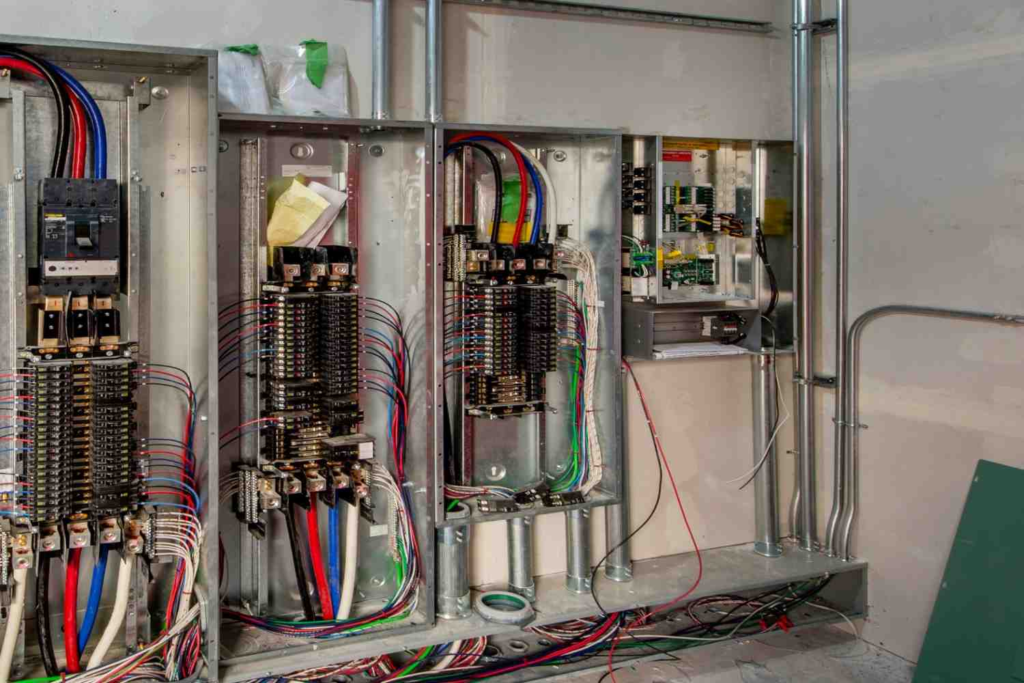
Main distribution equipment – The main switchboard, main distribution panel, or main breaker that distributes power from the service to the building circuits. Breaker condition, bus condition, equipment manufacturer and age, rated capacity, and evidence of overheating or arcing.
Panelboard condition throughout the building – Tenant electrical panels, floor distribution panels, and specialty panels throughout the building. Conductor condition within panels, breaker ratings relative to conductor sizes, directory accuracy, cover integrity, and clearance requirements.
Wiring systems – Visible wiring in mechanical spaces, electrical rooms, accessible ceiling spaces, and exposed locations. Conductor types, conduit types, raceway fill, support, and condition of visible sections.
Grounding systems – Grounding electrode conductors, equipment grounding continuity in accessible locations, and grounding at sensitive equipment.
Emergency and life safety systems – Emergency lighting, exit lighting, and fire alarm power systems have specific electrical requirements. These systems are assessed for proper dedicated circuits, appropriate equipment, and observable condition.
Energy metering and monitoring – Existing metering infrastructure for commercial energy management assessment.
Code compliance observations – Conditions that appear to deviate from applicable electrical codes, the National Electrical Code as adopted locally, are documented as part of the inspection.
Electrical Safety Compliance Requirements for Commercial Buildings
Commercial electrical safety compliance involves multiple overlapping requirements.
NFPA 70 (National Electrical Code) – The primary installation standard. Adopted by most jurisdictions with local amendments.
NFPA 70E – Standard for Electrical Safety in the Workplace. Governs arc flash hazard assessment, safe work practices, and personal protective equipment requirements for electrical work in commercial and industrial settings.
OSHA electrical safety standards – OSHA 29 CFR 1910 Subpart S for general industry electrical safety.
Local building code requirements – Local amendments to the NEC and locally adopted electrical standards.
Insurance carrier requirements – Many commercial property insurers have specific electrical system requirements. Certain conditions, aluminum branch circuit wiring, Federal Pacific or Zinsco panels, specific high-risk equipment configurations, may affect insurance coverage or premiums.
Tenant lease compliance – Commercial leases may include specific electrical system requirements or obligations on the landlord to maintain electrical systems to specified standards.
Non-compliance with applicable standards creates a combination of safety risk, regulatory risk, and insurance risk that commercial property owners need to understand and manage.
How Commercial Electrical System Condition Affects Capital Planning
Commercial electrical systems represent a significant capital investment and a significant capital risk if deferred maintenance or aging creates failure conditions.
Service upgrade needs – If load calculations confirm that the existing service is undersized for current or planned loads, service upgrade is a capital expenditure that requires utility coordination and may have significant lead time in some markets.
Distribution equipment replacement – Electrical switchgear, motor control centers, and distribution panels have expected service lives. Equipment approaching or past expected useful life is a capital planning consideration. Modern equipment also typically incorporates improved arc flash protection and monitoring capability compared to older vintage equipment.
Wiring system remediation – Aluminum branch circuit wiring, deteriorated conduit systems, or wiring systems that require significant code remediation can represent substantial capital investment.
Preventive maintenance programs – Annual infrared thermography of electrical panels and connections identifies hot spots that indicate connection problems before they cause failures. Annual thermography is a maintenance expense that prevents emergency repair costs and unplanned equipment failures.
Emergency power systems – Generators, UPS systems, and automatic transfer switches age independently of the main electrical system and have their own capital replacement cycles.
LiteHouse Commercial documents commercial electrical systems conditions with findings and remaining useful life assessments that feed directly into capital planning and property condition reports.
Conclusion
Commercial electrical systems are complex, high-stakes infrastructure that affect building safety, operational reliability, tenant satisfaction, and regulatory compliance simultaneously. Understanding 3-phase power distribution, load capacity, safety hazards, and the current condition of the electrical system is essential information for anyone managing or investing in commercial real estate.
LiteHouse Commercial provides comprehensive commercial electrical inspections as part of complete property condition assessments. Whether the goal is pre-acquisition due diligence, capital planning baseline, or independent assessment of system condition, our team delivers the information commercial property stakeholders need. Reach out to our team to discuss inspection requirements for a specific commercial property.
Frequently Asked Questions
What is infrared thermography and how is it used in commercial electrical inspections? Infrared thermography uses a thermal imaging camera to detect temperature differences in electrical equipment, such as panels, connections, motors, and transformers. Elevated temperatures at electrical connections indicate resistance from loose, corroded, or overloaded connections that are releasing heat. These hot spots precede failures. Infrared scanning of commercial electrical equipment identifies developing problems before they cause outages or fires. It is a standard preventive maintenance practice in well-managed commercial facilities and is sometimes incorporated into insurance programs.
How can I determine if existing electrical service capacity is enough for adding EV charging infrastructure?
EV charging load is significant, a Level 2 commercial charger draws 7.2 to 19.2 kW per port, and DC fast chargers draw 50 to 350 kW. Adding multiple charging stations creates a substantial load addition to the building's electrical service. A load calculation comparing existing service capacity against current building loads plus the proposed EV charging load determines whether the existing service can accommodate the addition or whether service upgrade is required. This calculation needs to be done before EV charging infrastructure is committed to rather than after purchase.
What documents should a commercial property owner maintain for the electrical system?
Useful electrical system documentation includes as-built electrical drawings showing panel locations, circuit routing, and load assignments; panelboard directories that accurately reflect current circuit use; equipment maintenance records for major electrical equipment including switchgear, transformers, and motors; infrared thermography reports from periodic testing; arc flash hazard assessment documentation; utility metering history; and any permits and inspection records for electrical modifications. Good documentation supports maintenance decisions, emergency response, tenant operations, and transaction due diligence.